
The AI SEO Guide: From Concepts to Application
July 28th, 2026 by
Note: This post was updated by Will Scott on July 28th, 2026 to reflect current best practices. It was originally published on May 8th, 2025.
TL;DR: AI SEO is the practice of optimizing content so it performs well with both human readers and AI systems like ChatGPT, Perplexity, and Google’s AI Overviews. It builds on traditional SEO foundations, crawlability, site structure, and E-E-A-T, while adding new priorities: semantic depth, self-contained answer chunks, entity authority, and structured data that AI can retrieve and cite. Success today means measuring citations and brand presence in AI answers, not just clicks.
Key Insights
- AI SEO means creating content that resonates with humans and is easily interpreted by AI systems.
- Search engines prioritize semantic relevance, so depth and clarity now matter more than exact keywords.
- AI models pull from trusted sources, making content accuracy and accessibility essential.
- Content should align with user intent and be structured in self-contained chunks that AI can retrieve.
- Winning at AI SEO requires ongoing effort, fresh content, and the right tools to track AI visibility.
- AI SEO spans multiple disciplines: technical optimization, content strategy, entity building, and measurement.
What Is AI SEO? A Complete Definition
AI SEO is the strategic optimization of digital content to perform well with human visitors and artificial intelligence systems, including search engines, voice assistants, chatbots, and generative AI platforms like ChatGPT, Perplexity, and Google’s AI Overviews.
AI SEO is sometimes called:
- Generative Engine Optimization (GEO) — optimizing for AI-generated search answers
- Answer Engine Optimization (AEO) — structuring content to be surfaced by answer engines
- LLM Optimization — making content retrievable and citable by large language models
As we enter an era where content is increasingly filtered through AI tools, your content must serve two audiences simultaneously: your human customers and the AI models deciding what content to surface.
Those models rarely take a question at face value. They split it into a fan of related sub-queries and pull the best source for each, a behavior known as query fan-out.
How to apply it: Before optimizing any page, ask two questions: (1) Is this content valuable to a human reader? (2) Can an AI system quickly identify, extract, and cite the key claims? If both answers are yes, you’re on the right track.
How Is AI SEO Different From Traditional SEO?
Traditional SEO focused on ranking pages for specific keywords so users would click through. AI SEO expands that goal. You now need content that can be cited inside AI-generated answers, not just ranked.
| Traditional SEO | AI SEO |
|---|---|
| Rank for keywords | Get cited in AI answers |
| Optimize for crawlers | Optimize for LLM retrieval |
| Build backlinks | Build entity authority |
| Target exact-match keywords | Target semantic topic coverage |
| Measure clicks | Measure citations + brand presence |
The good news: foundational SEO still matters. Clean site structure, crawlability, authority signals, and E-E-A-T all carry over. AI SEO builds on that foundation rather than replacing it.
→ Deep dive: AI SEO fundamentals — what’s changed and what hasn’t
Part 1: Foundations — What Powers AI SEO
Artificial Intelligence (AI)
What it is: AI is software that learns from data to make decisions, generate content, or answer questions. In the context of search, AI systems analyze massive datasets to understand language, intent, and the relationships between concepts.
In your website’s world, AI helps with:
- Answering customer questions automatically
- Suggesting content your visitors might like based on their behavior
- Improving your SEO by understanding what your content means, not just what keywords it contains
How to apply it: Ask ChatGPT to analyze one of your web pages and suggest improvements. You’ll get a hands-on look at how AI “sees” your content: what it understands, what’s unclear, and what’s missing. This perspective should inform every content decision.
Large Language Models (LLMs)
What they are: LLMs, like GPT-4, Claude, or Gemini, are a category of AI software that process and generate human language based on vast amounts of text data they’ve analyzed. These are the engines powering ChatGPT, Google’s AI Overviews, Perplexity, and similar tools.
For AI SEO specifically, your team can use LLMs to:
- Create search-optimized content that addresses search intent
- Generate blog ideas based on trending topics and search volume
- Analyze top-performing search results to identify content gaps
- Draft meta descriptions and title tags that improve click-through rates
- Develop FAQ sections that address common user queries
How to apply it: Use an LLM to stress-test your content. Paste your page into ChatGPT and ask: “Based on this content, how would you answer the question [your target query]?” If the answer is vague or incorrect, your content needs work.
Embeddings in Search Engines
What they are: Embeddings transform text into numerical vectors that capture meaning. Modern search engines use embeddings to understand the topics in your content, not just its exact words.
For example:
- “Buy running shoes” and “purchase athletic footwear” would have similar embeddings despite using different words.
- This allows search engines to match your content with user queries based on meaning, not just exact keyword matches.
How to apply it: Stop writing for keyword density. Instead, write for topic completeness. A page about AI SEO should naturally cover related concepts, LLMs, embeddings, RAG, entity optimization, E-E-A-T, because that’s what topically authoritative content looks like. Tools like Surfer SEO or Clearscope can help identify semantic gaps.
Vectors and AI-Driven Search Results
What they are: Vectors are the mathematical representations of your content that search engines use to match with search queries. Each piece of content has a unique vector “signature” based on its topics and meaning. Search algorithms compare query vectors with content vectors to determine relevance.
How to apply it: Use AI SEO tools to analyze your highest-performing organic content and identify the semantic topics driving its success. Then, apply those learnings to underperforming pages by enriching their topical coverage.
Part 2: Making AI Smarter — Grounding and RAG
Grounding
What it is: AI systems can “hallucinate,” confidently stating things that are wrong. Grounding is the practice of connecting AI to reliable sources of truth so it answers accurately.
In practical terms, grounding means connecting AI to:
- Your website content
- Product catalogs
- Knowledge bases
- Customer support archives
For AI SEO, grounding is why your content quality matters so much. AI systems are trained to prefer sources that are accurate, current, and well-structured. Pages that pass those tests get cited more often.
How to apply it: Treat every page on your site as a potential AI source document. Ask: Would an AI system trust this page as authoritative? Check for outdated statistics, unsupported claims, and missing author/credential signals, all of which reduce your content’s “groundability.”
RAG: Retrieval-Augmented Generation
What it is: RAG is the framework that makes grounding possible in AI-powered search. The three-step process:
- Retrieve: The AI searches for relevant content in its database or on the internet (using vector coordinates).
- Augment: It adds this information to its working memory.
- Generate: It crafts a helpful, accurate response using this retrieved information.
RAG powers:
- Google’s AI Overviews that summarize search results
- Custom GPTs with access to your content
- Site search that gives conversational answers
- Enterprise chatbots that know your specific business
How to apply it: Structure your content for retrieval. This means clear headings, distinct topic sections, and self-contained answer passages. Each section of your page should be able to stand alone as a reliable answer to a specific question.
→ See also: how to optimize content for AI search for tactical implementation
Part 3: Structuring Content — Relevance, Salience, and Granularity
Topical Relevance
What it is: Topical relevance means your content matches what people are looking for. Not just in terms of keywords, but the concepts behind them.
How to apply it:
- Focus each page on one clear topic. Avoid the “everything bagel” approach.
- Use natural language that covers related terms and concepts.
- Match the underlying intent, not just the exact search terms.
- Build topic clusters: a pillar page covering the broad concept, supported by cluster pages diving into each subtopic.
Salience
What it is: Salience is about prominence and focus. Is your core topic front-and-center, or just mentioned in passing?
Low-salience example: “We offer a range of services, including SEO, PPC, email, social media, and more.”
High-salience example: “Our SEO strategy begins with a technical audit, followed by keyword mapping and targeted content updates to drive organic rankings.”
The second is focused. That focus is what makes content salient and retrievable.
How to apply it: Run a salience check on your top pages. For each page, can you identify the primary topic in the first 100 words? Is the H1 specific and concept-forward? Does the page stay focused throughout, or does it drift? Salient content gets retrieved more often by AI systems and ranks better in traditional search, too.
Chunks (Passages): The Unit of Retrieval
What they are: Modern search engines and AI don’t read your content like humans do. They break it into bite-sized pieces called “passages” or “chunks.” When someone asks a question, AI might pull just the relevant chunk, not your entire page.
How to apply it:
- Use clear subheadings that state the main idea (questions work especially well).
- Make each section answer a specific question.
- Keep related information together.
- Aim for self-contained sections that make sense on their own.
- Avoid burying key answers in the middle of long paragraphs. Lead with the answer, then support it.
→ See how AI systems “chunk” your site: Search Influence’s Web Content Chunker
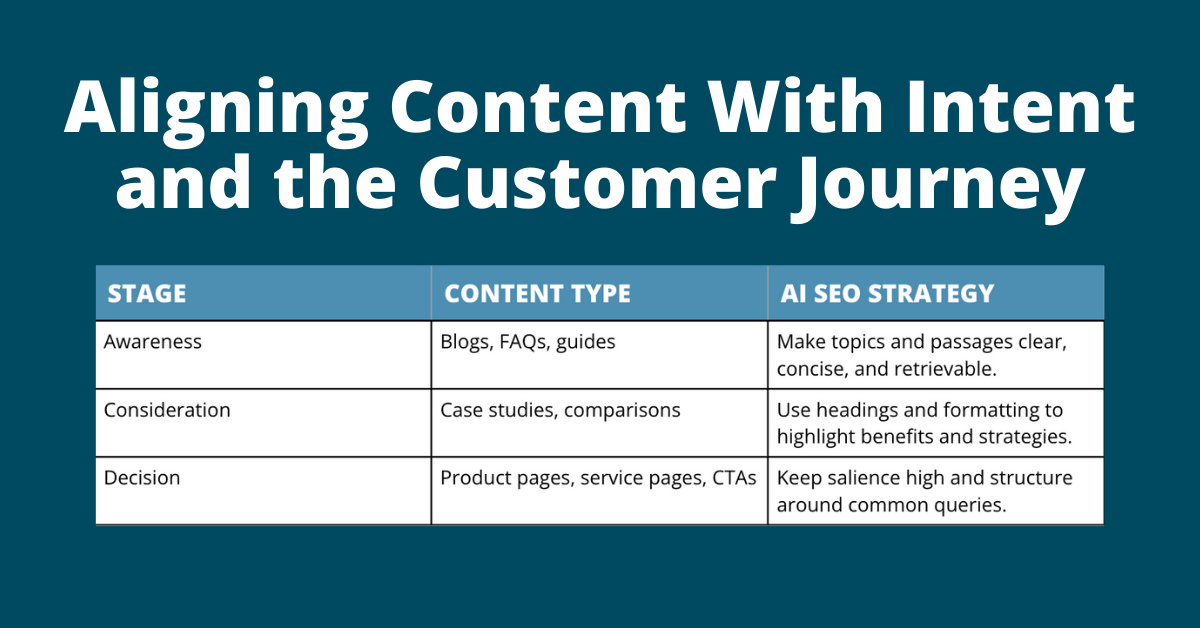
Part 4: Aligning Content With Intent and the Customer Journey
Understanding User Intent
What it is: User intent is the “why” behind a search. It’s the difference between someone researching a topic and someone ready to buy.
- Informational: “What is AI SEO?” (They want to learn.)
- Navigational: “Search Influence AI SEO services” (They’re looking for a specific site.)
- Transactional: “Hire AI SEO agency” (They’re ready to act.)
- Investigative: “Best AI SEO firm for higher education” (They’re comparing options.)
How to apply it: Before writing any page, clearly define which intent type it serves. Then, make sure every element of the page aligns with that intent — headline, body content, calls to action, and internal links. A page trying to serve multiple intents usually serves none of them well.
Matching Content to Intent
The AI concepts covered in Parts 1–3 come together here. Use topical relevance to ensure you’re covering the right concepts; apply salience to focus your content on what matters most; structure your content in chunks that answer specific questions.
How to apply it: Map each of your key pages to a specific intent stage. Review the content and ask: Does this page actually deliver on what the intent signals? Intent mismatch is one of the most common and most fixable AI SEO problems.
Mapping to the Customer Journey
Your website is a journey. Effective AI SEO ensures you have strong content at every stage: awareness, consideration, and decision. AI systems surface content based on where users are in their journey, so gaps in your content map mean missed citation opportunities.
How to apply it: Audit your content by journey stage. Are you heavy on awareness but light on decision content? Do you have content that addresses comparison questions (a high-value investigative-intent category)? Fill the gaps before you optimize existing pages.
Keep It Fresh: Why Content Age Matters in AI Retrieval
What it is: Both search engines and AI systems prefer fresh content. Not just a recent publication date, but current information.
How to apply it:
- Set a calendar reminder to review key pages quarterly.
- Update statistics, examples, and tool references regularly.
- Add “Last Updated” dates to show content freshness.
- Prioritize pages that reference time-sensitive information (statistics, platform features, competitive landscapes).
Invisible SEO: Metadata, Markup, and Machine Signals
What it is: AI doesn’t just see what humans see. It reads the code behind your pages. These behind-the-scenes signals help machines understand your content:
- Semantic HTML: Using proper heading tags (H1, H2) instead of just making text bigger
- Schema markup: Adding structured data that explicitly tells search engines “this is a product” or “this is an FAQ”
- Meta information: Writing compelling, keyword-relevant titles and descriptions
- Image alt text: Describing images for both accessibility and AI context
How to apply it: Use Google’s Rich Results Test to see what structured data your site currently has. FAQ schema is particularly high-value for AI Overview citations. Every page that answers common questions should have it.
Part 5: Entity Optimization — The New Keyword Strategy
What Are Entities?
What they are: Entities are the people, places, things, and concepts that AI systems track and connect in knowledge graphs. Search engines no longer just index keywords. They build structured models of who you are, what you do, and how you relate to other entities in your industry.
For a business, your entities include:
- Your brand name and its associated products/services
- The people at your company (authors, executives)
- Your industry and specialization categories
- The problems you solve and the audiences you serve
How to apply it: Audit how Google’s Knowledge Graph currently represents your brand. Search your brand name. Does a Knowledge Panel appear? What category does it assign you? What related entities does it connect you to? This tells you where your entity optimization stands today.
→ Want to better understand the entities on your pages? Try Search Influence’s Ontologoizer.
Knowledge Graphs: Entities and Relationships
What they are: Search engines use knowledge graphs to understand entities and how they relate to each other. This structured understanding helps AI comprehend context and meaning beyond just keywords.
For example, a knowledge graph understands that “Apple” could be a fruit, a technology company, or a record label, and it understands which one based on the surrounding context.
How to apply it:
- Use schema markup to clearly identify entities on your pages.
- Build content that reinforces your entity relationships.
- Create content clusters that thoroughly cover related topics in your space.
- Earn citations and mentions from authoritative sources in your industry; these build entity authority.
- Ensure your brand is described consistently across your website, social profiles, and third-party listings.
E-E-A-T: Building Trust With Both Users and AI
What it is: Google’s E-E-A-T framework (Experience, Expertise, Authoritativeness, Trustworthiness) describes the quality signals that indicate a trustworthy source. AI systems are increasingly using similar signals to decide which content to retrieve and cite.
- Experience: Show first-hand knowledge and practical application.
- Expertise: Demonstrate deep understanding of your field.
- Authoritativeness: Build recognition from others in your industry.
- Trustworthiness: Provide accurate, current information with transparency.
How to apply it: Audit your key pages for E-E-A-T signals. Does each page clearly identify the author and their credentials? Do you reference authoritative external sources? Do you show real-world experience with specific examples and results? Pages that score well on E-E-A-T are significantly more likely to be cited in AI-generated answers.
Part 6: Content Structure for AI Citation
Writing Self-Contained Answer Passages
What it is: AI systems extract specific passages from your content to use in generated answers. Those passages need to make sense on their own, without the surrounding context of the full page.
How to apply it:
- Write direct answers at the start of each section, then elaborate.
- Avoid answers that depend on reading the previous section to make sense.
- Use the inverted pyramid: most important information first.
- Bold key claims and definitions so they’re easy to extract.
Using Headers as Answer Frames
What it is: Headers in your content serve double duty. They help human readers navigate, and they signal to AI systems what each section is about. Headers formatted as questions closely match the queries that trigger AI Overviews.
How to apply it:
- Convert at least some H2s and H3s to question format (“What is…?” “How do I…?” “Why does…?”)
- Make each header specific enough to match a real user query.
- Follow each question-format header with a direct, concise answer in the first 1–2 sentences.
The use of appropriate headings is also valuable for accessibility, one of Google’s Agent-Friendly website factors.
Tables, Lists, and Structured Formats
What they are: Structured formats, comparison tables, numbered steps, and bulleted lists are disproportionately effective at earning AI citations because they’re easy to extract and present in AI-generated answers.
How to apply it:
- Use comparison tables for “X vs. Y” topics (like the AI SEO vs. traditional SEO table earlier in this guide).
- Use numbered lists for sequential processes.
- Use bulleted lists for non-sequential sets of items.
- Avoid burying structured information in long prose paragraphs.
Part 7: Technical AI SEO Foundations
Crawlability and Indexability
What it is: For your content to be retrieved by AI systems, it first needs to be crawled and indexed. Basic technical SEO hygiene is the prerequisite for everything else.
How to apply it:
- Verify your robots.txt isn’t blocking important pages.
- Ensure your XML sitemap is submitted in Google Search Console.
- Check that your key pages are indexed (use site:yourdomain.com/page-url in Google).
- Resolve crawl errors in GSC before investing in content optimization.
Structured Data / Schema Markup for AI
What it is: Schema markup is code that explicitly tells search engines what your content is and what it means. For AI SEO, it’s one of the highest-leverage technical tactics available.
The most valuable schema types for AI citation:
- FAQ schema — directly feeds question-answer format into AI Overviews
- HowTo schema — signals procedural content
- Article schema — establishes content type and author
- Organization schema — strengthens entity signals
- Breadcrumb schema — helps AI understand site structure
How to apply it: Use Google’s Rich Results Test and the Schema Markup Validator to check current implementation. Prioritize FAQ schema on any page targeting informational queries. It’s the single highest-impact schema type for AI Overview citations.
Internal Linking as Topic Signaling
What it is: Internal links tell AI systems how your content is organized and which pages are most important. A well-structured internal linking architecture helps AI understand your topical authority across a subject area.
How to apply it:
- Build clear hub-and-spoke structures: pillar pages link to cluster pages, cluster pages link back to pillar pages.
- Use descriptive anchor text that signals the topic of the linked page.
- This guide serves as the AI SEO hub — linking to:
- AI SEO fundamentals — what’s changed and what hasn’t
- How to optimize content for AI search — tactical content optimization
- AI search KPIs — measuring AI visibility
- Search Influence AI SEO services — working with an AI SEO partner
Part 8: Measurement — Tracking AI SEO Performance
Why Traffic Is No Longer Enough
Traditional SEO success was measured in clicks. AI SEO requires a more complete picture: AI systems can influence a user’s decision before they ever visit your site. Brand presence in AI-generated answers, citation frequency, and brand representation accuracy are now critical metrics alongside traffic.
The AI SEO Measurement Framework
Tier 1 — Visibility Signals:
- AI Overview appearances (track via SEMrush or Advanced Web Ranking)
- Chat platform citations (test manually in ChatGPT, Perplexity, Gemini)
- Featured snippet presence
Tier 2 — Engagement Indicators:
- Organic CTR on AI-adjacent queries
- Time-on-page and scroll depth for pillar content
- Direct/branded traffic (indicates AI attribution)
Tier 3 — Business Outcomes:
- Leads and conversions from informational intent pages
- Brand mentions in third-party content (signals growing authority)
How to apply it: Set up a monthly AI visibility audit. Manually test your 10 most important query targets in ChatGPT, Perplexity, and Google AI Overviews. Track whether you’re cited, how you’re described, and which competitors appear instead of you. Dedicated tools like Scrunch, RankScale, or Profound can automate this at scale.
AI SEO Glossary
A quick-reference guide to key AI SEO terms and concepts.
| Term | Definition |
|---|---|
| AI Overview | Google’s AI-generated summary that appears at the top of search results, synthesizing information from multiple sources to answer user queries directly. |
| AI Mode | Google’s conversational search interface that generates comprehensive answers using AI, moving beyond traditional blue-link results. |
| Answer Engine Optimization (AEO) | The practice of optimizing content to be surfaced by answer engines and voice assistants that provide direct answers rather than lists of links. |
| Agentic Search | AI-powered search where an AI assistant proactively searches, researches, and takes actions on behalf of the user. |
| Chunk / Passage | A discrete unit of content (typically a section under a heading) that AI retrieval systems extract and evaluate independently. |
| E-E-A-T | Experience, Expertise, Authoritativeness, Trustworthiness — Google’s quality evaluation framework for content and sources. |
| Embeddings | Mathematical representations of text that capture semantic meaning, enabling AI systems to match content based on topic rather than exact keywords. |
| Entity | A distinct, identifiable concept (a person, place, organization, product, or idea) that AI systems track and connect in knowledge graphs. |
| Entity Optimization | The practice of strengthening how AI systems recognize, understand, and represent your brand as an entity across the web. |
| GEO (Generative Engine Optimization) | Optimizing content specifically to be cited, retrieved, and surfaced by generative AI systems like ChatGPT and AI Overviews. |
| Grounding | Connecting AI systems to reliable, current information sources to prevent hallucination and improve accuracy. |
| Hallucination | When an AI system confidently generates inaccurate or fabricated information, typically because it lacks reliable grounding sources. |
| Knowledge Graph | A structured database of entities and their relationships that search engines use to understand context and meaning. |
| LLM (Large Language Model) | A type of AI trained on massive text datasets to understand and generate human language. GPT-4, Claude, and Gemini are examples. |
| LLM Citation | Being referenced or sourced by an AI language model in a generated answer. |
| Query Fan-Out | The behavior of AI search systems that split a single user query into multiple related sub-queries to build a comprehensive answer. |
| RAG (Retrieval-Augmented Generation) | An AI architecture that retrieves relevant content from a database before generating a response, improving accuracy and grounding. |
| Salience | The degree to which a subject is the clear, central focus of a piece of content. |
| Schema Markup | Structured data code added to web pages that explicitly communicates content type and meaning to search engines and AI systems. |
| Semantic SEO | Optimizing for the meaning and context of content rather than exact-match keywords. |
| Topical Authority | The degree to which a website or content creator is recognized as a comprehensive, trustworthy expert on a given topic area. |
| Vector Search | AI-powered search that compares the mathematical representations of queries and content to determine relevance based on meaning. |
| Zero-Click Search | Search interactions where users get their answer directly on the results page (via AI Overviews, featured snippets, etc.) without clicking through to a website. |
Frequently Asked Questions About AI SEO
How is AI SEO different from traditional SEO?
Traditional SEO focuses on ranking pages so users click through. AI SEO adds a second objective: getting your content cited inside AI-generated answers, where users may form opinions about your brand before ever visiting your site. Traditional SEO optimizes for crawlers and keywords; AI SEO also optimizes for LLM retrieval, entity recognition, and structured content that AI can extract and summarize. The tactics are complementary. Foundational SEO is still required, but AI SEO extends it.
How do I do AI SEO?
AI SEO implementation involves five core areas:
- Structure content as self-contained answer passages with clear headers
- Implement schema markup, especially FAQ schema, to explicitly signal content type to AI systems
- Build topical authority through content clusters covering your subject area comprehensively
- Optimize entity signals so AI systems correctly understand and represent your brand
- Measure AI visibility through citation tracking in ChatGPT, Perplexity, and Google AI Overviews, alongside traditional traffic metrics
Does traditional SEO still matter for AI SEO?
Yes, foundational SEO is the prerequisite for AI SEO. Clean site structure, crawlability, technical health, and authority signals all carry directly into AI search performance. AI systems can only retrieve content that’s properly crawled and indexed. E-E-A-T signals, the same ones that improve traditional rankings, also determine which sources AI systems choose to cite.
How do I measure AI SEO performance?
AI SEO measurement requires tracking beyond organic traffic. Key metrics include: AI Overview appearances, citation frequency in ChatGPT and Perplexity, brand representation accuracy in AI-generated answers, and branded search volume. Tools like SEMrush, Advanced Web Ranking, Scrunch, RankScale, and Profound can track AI visibility at scale.
Working With an AI SEO Partner
Implementing AI SEO effectively requires ongoing effort across content, technical, and measurement disciplines. Search Influence’s AI SEO services are designed to help businesses build visibility across both traditional and AI-driven search.